
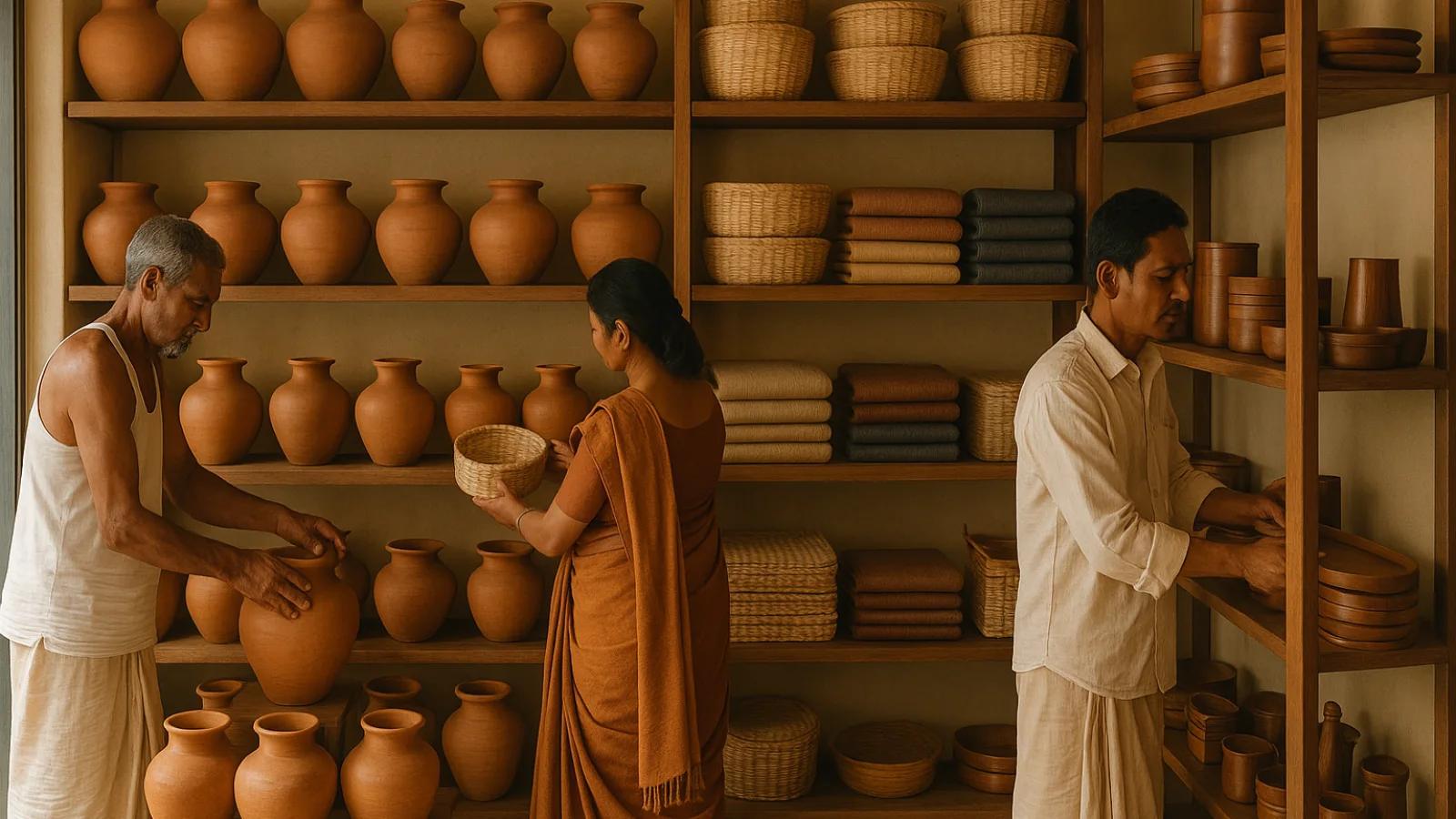
Quick answer: The Government of India's July 21 update on a second operational PM Vishwakarma airport stall is not an announcement of a stall in Tarapur or Bihar. It is, however, a useful signal for local traditional artisans: wider market access rewards consistent products or services, clear pricing, presentable display, dependable fulfilment and accurate records. A Tarapur artisan can start building that readiness locally before pursuing any verified scheme opportunity.
What changed on July 21, 2026?
The Ministry of Micro, Small and Medium Enterprises reported through the Press Information Bureau that a PM Vishwakarma stall at Shaheed Bhagat Singh International Airport, Chandigarh, was inaugurated on July 14. It is the second operational airport stall under this initiative, after the first at Raja Bhoj Airport in Bhopal. The Chandigarh stall was set up with support from NABARD and a self-help group and is being operated by three beneficiaries: a basket maker, a traditional doll and toy maker, and a potter.
The practical lesson is broader than an airport counter. The ministry says the stall gives artisans a chance to meet customers, observe preferences, improve product presentation and explore wider markets. Those same disciplines can be practised in a Tarapur shop or workshop: keep a focused range, make quality repeatable, explain prices clearly, display work neatly and record what customers actually request.
What this update does not mean for Tarapur
No cited official source announces an airport stall, reserved retail space, automatic market placement or guaranteed sales for Tarapur artisans. Registration under a scheme also does not by itself guarantee selection for an exhibition, online platform or physical stall. Artisans should verify current eligibility, application status and market-support opportunities only through the official PM Vishwakarma portal, the nearest Common Service Centre and authorised government channels.
Balram Complex is not presented as a scheme office or an official PM Vishwakarma facility. Its relevance is practical: an artisan who needs a customer-facing shop, sample display, service counter, order desk or organised local workshop can assess whether an available commercial unit supports that operating model. Availability, dimensions, permitted use, fit-out responsibility and lease terms must be confirmed directly during enquiry and site inspection.
Which traditional trades should check the scheme?
The official MSME scheme booklet lists 18 covered trades: carpenter, boat maker, armourer, blacksmith, hammer and tool-kit maker, locksmith, goldsmith, potter, sculptor or stone carver and stone breaker, cobbler or footwear artisan, mason, basket or mat or broom maker and coir weaver, traditional doll and toy maker, barber, garland maker, washerman, tailor and fishing-net maker. Eligibility depends on the scheme's current rules and verification process, not simply on using a similar business name.
For product-led trades such as pottery, basket making, tailoring, footwear, toys or woodwork, market readiness often means samples, finish consistency, packaging and delivery planning. For service-led trades such as barbering, washing, masonry or lock work, readiness may mean a clean service counter, appointment handling, tool organisation, job records and a clear explanation of scope and turnaround time.
A seven-part retail-readiness plan
- Choose a focused offer. Start with a manageable group of products or services that can be delivered repeatedly. Separate made-to-order work from ready stock so buyers understand what is immediately available.
- Set a quality check. Decide what must be inspected before sale: dimensions, finish, stitching, balance, smooth edges, cleanliness, colour consistency, moving parts or service completion. Keep rejected or repair-needed work away from the customer display.
- Prepare honest product information. Record material, size, care instructions, maker details and realistic completion time where relevant. Do not invent certifications, origin claims or performance guarantees. Any label should be accurate and legible.
- Build a price and cost sheet. Track material, labour, packaging, transport, marketplace fees, breakage or rework and a sustainable margin. Use one current price list so walk-in, phone and online quotations do not conflict.
- Design the display for decisions. Keep the best samples at eye level, group similar products, leave a clear customer path and reserve a small area for discussion or measurements. A service business should show the process and expected timing without exposing private customer information.
- Accept and record payments properly. Use verified payment details, issue receipts where applicable, reconcile daily collections and keep personal and business records distinguishable. Digital-payment incentives under PM Vishwakarma have specific rules; confirm them officially rather than assuming every transaction qualifies.
- Prepare for fulfilment. Note stock on hand, work in progress, promised dates, buyer contact, dispatch or pickup status and any advance received. Wider reach is useful only when the artisan can deliver the promised item or service consistently.
How a local commercial space can support artisan growth
A market-facing space can combine several functions, but each needs a defined zone. The entrance should help customers understand the offer quickly. Samples need clean, dry shelves. Tools and unfinished work should remain safely separated from the customer path. Packing materials need storage that does not crowd the display. Orders, receipts and customer measurements should be handled at a small counter with appropriate privacy.
During a Balram Complex site visit, an artisan should test the real workflow rather than judge only the frontage. Ask where finished goods, raw material and tools will go; whether light and ventilation suit the work; how customers will wait; how fragile or bulky items will move; where power points are located; and which alterations require approval. Service trades should also consider water, hygiene, noise and waste needs, then verify whether the proposed use is permitted and technically practical.
A 30-day action sequence for Tarapur artisans
- Days 1-7: Confirm the exact trade, review official eligibility information, visit the nearest CSC if applying, and list the current products or services that can be delivered reliably.
- Days 8-14: Create a quality checklist, current price sheet, simple order register and inventory list. Photograph only finished work in clean light for your own catalogue.
- Days 15-21: Test packaging, pickup and local delivery. Ask a small group of real customers what information they need before buying and record repeated questions.
- Days 22-30: Arrange samples as a compact display, review payment and receipt practice, calculate working-stock needs, and inspect a commercial space only if the workflow and budget are ready.
Mistakes to avoid
- Do not claim that the Chandigarh airport initiative is available in Tarapur unless an authorised source announces it.
- Do not produce large inventory only because a market-access story is encouraging; test demand and cash flow first.
- Do not mix rough work, tools, finished goods and customer movement in one unsafe area.
- Do not promise delivery dates without checking material, labour and transport capacity.
- Do not pay an unofficial intermediary for guaranteed registration, selection or market placement.
Frequently asked questions
Has a PM Vishwakarma airport stall opened in Tarapur?
No. The July 21 PIB release concerns the second operational airport stall at Chandigarh, following Bhopal. The cited sources do not announce a Tarapur or Bihar airport stall. Local artisans should treat the news as a market-readiness example, not a local placement offer.
Does PM Vishwakarma cover every small shop?
No. The official booklet identifies 18 traditional trades and the scheme has an eligibility and verification process. A general retailer or an activity outside those trades should not assume coverage. Check the current official rules and use the nearest CSC for application guidance.
Can a scheme registration guarantee exhibition or online sales?
No official source cited here guarantees sales or automatic placement. The scheme includes marketing-support mechanisms, but participation and outcomes depend on current programmes, selection, product or service readiness and buyer demand. Verify each opportunity through authorised channels.
What should a product artisan prepare before seeking a shop?
Prepare a focused sample range, quality checklist, honest product information, cost-based price sheet, stock register, packaging test and fulfilment plan. Then inspect whether the shop can separate display, work, storage and customer movement safely.
What should a service artisan check during a site visit?
Map the service counter, waiting area, tools, privacy, power, ventilation, water, hygiene, waste and noise needs. Confirm permitted use and alteration responsibility with management before committing. Requirements differ for trades such as tailoring, barbering, repair, washing and masonry coordination.
Where should a Tarapur artisan verify PM Vishwakarma information?
The MSME booklet directs applicants to the nearest Common Service Centre for online applications and to the official PM Vishwakarma portal for details. Use government sources for current rules and avoid anyone promising guaranteed approval or market placement.
Bottom line
The new airport stall shows that presentation and direct customer learning are becoming part of artisan market access. For Tarapur, the responsible next step is not to copy an airport format or assume a benefit. It is to build a reliable local operation: consistent quality, transparent information, disciplined pricing, organised display, accurate orders and a shop workflow that customers can trust.
Official sources
- PIB: PM Vishwakarma artisans gain enhanced market access at airports, July 21, 2026
- Ministry of MSME scheme booklet: PM Vishwakarma benefits, covered trades and application route
- Official PM Vishwakarma portal for current scheme information
- Munger district administration: official Tarapur block office listing
Plan your setup: Use the Book Site Visit button to inspect Balram Complex units for an artisan display, service counter or organised workshop. Confirm current availability, permitted use and commercial terms directly with management.