
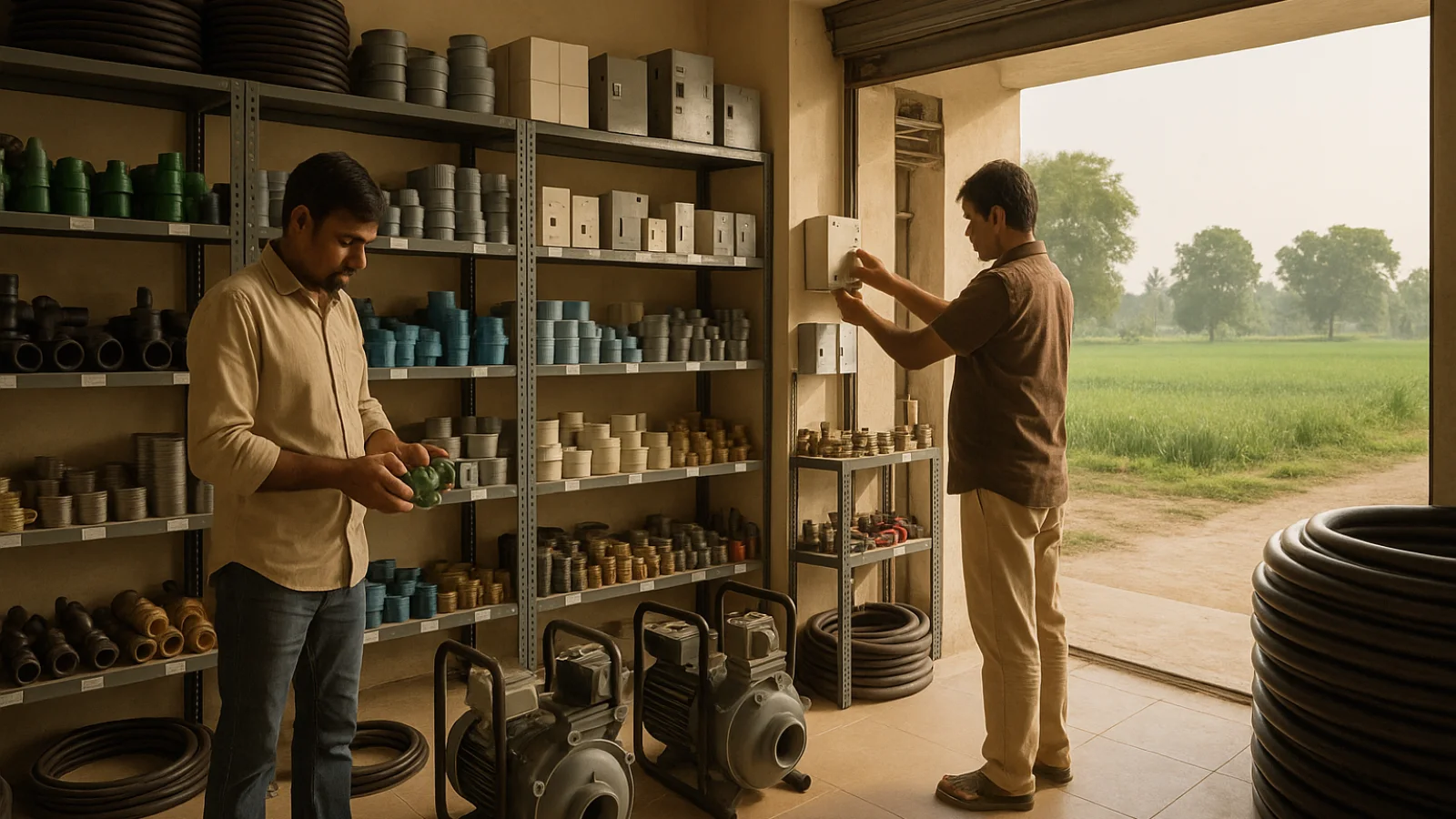
What Bihar announced on 9 July 2026
The Bihar Chief Minister Secretariat listed a 9 July 2026 direction that agricultural feeders should provide electricity to farmers from 6:00 AM to 6:00 PM. For Tarapur, this is a useful operating signal for businesses connected with irrigation, farm inputs, pump service, electrical parts, plumbing, hardware and field support. It is not a promise that every feeder will immediately deliver uninterrupted twelve-hour supply in every location.
Implementation can vary by feeder condition, maintenance, weather, load management and local distribution arrangements. Shop owners should therefore treat the announcement as a planning trigger, then confirm the actual schedule and outage information through South Bihar Power Distribution Company Limited (SBPDCL) or the relevant local office before changing stock or staffing.
Why the update matters to the Tarapur market
Munger district's official administrative hierarchy places Tarapur, Asarganj and Sangrampur blocks within Tarapur subdivision. This creates a practical rural service context around the town: customers may travel to Tarapur for parts, advice, repairs, documents and replenishment that are not available close to a field or village. A more predictable daytime irrigation window could concentrate some questions and purchases before work starts, during equipment failure and after field activity ends.
The opportunity should not be overstated. The government announcement does not publish Tarapur-specific footfall, sales or demand projections. A retailer should watch actual enquiries for two to four weeks and expand only those product lines that show repeat movement. The right response is better readiness, not speculative overstocking.
How agricultural feeder separation fits the picture
SBPDCL's official rural-electrification page explains that separating agricultural and non-agricultural feeders is intended to support more considered supply management for rural consumers. The page reports company-wide infrastructure under the Deen Dayal Upadhyaya Gram Jyoti Yojana, including dedicated 11 kV agricultural feeders and agricultural distribution transformers. Those numbers describe the SBPDCL service area; they are not Tarapur-specific counts.
For a local business, feeder separation matters because the farm customer's operating day may differ from a general retail customer's day. If irrigation activity is expected during daylight hours, urgent demand may shift toward early opening, quick diagnosis, ready-to-carry spares and reliable phone support. Businesses can prepare for that pattern without making claims about guaranteed electricity or guaranteed sales.
Business categories that can plan around the signal
- Pump and motor service: Keep a clear intake process for fault description, model, power rating and photos. Separate repairs that can be completed at the counter from jobs requiring a technician or field visit.
- Electrical parts: Stock only properly rated, compliant products. Organise starters, switches, protection devices, cable accessories and common consumables by specification, not only by price.
- Pipe, plumbing and hardware: Use a measured list for common fittings, clamps, valves, connectors and repair items. Avoid promising compatibility without checking size and use.
- Agri-input retail: Plan seed, fertiliser and crop-protection sales only within applicable licences, storage rules, invoices and official guidance. A power-supply announcement does not replace product compliance.
- Mobile and digital services: Help customers store service contacts, submit permitted online requests, print documents and use digital payment. Never ask for or retain a customer's OTP, PIN or account password.
- Delivery and field support: Create defined service areas, charges, cut-off times and proof of delivery instead of accepting open-ended urgent requests.
Balram Complex already has dedicated planning pages for agri-input shop space in Tarapur, electrical shop space and businesses serving nearby villages. Use these as fit-out and customer-service checklists, not as demand guarantees.
Build a service-day plan before adding inventory
A simple operating plan can reveal whether the announcement changes the business at all. Record the time, item requested, village or service area, urgency and whether the enquiry converted into a sale. After enough real observations, compare four windows: before 8:00 AM, 8:00 AM to noon, noon to 4:00 PM and after 4:00 PM.
If early enquiries increase, test an earlier opening on selected days rather than permanently extending hours. If most requests arrive by phone, create a short message format asking for product name, size, model and photograph. If field calls interrupt counter service, assign fixed visit slots. If demand remains unchanged, keep the original schedule. Evidence should drive the change.
Use a minimum-stock method
For each fast-moving item, write down average weekly sales, supplier lead time and the smallest safety quantity that avoids frequent stock-outs. Reorder when usable stock approaches expected demand during the lead time plus that safety quantity. Review slow-moving items separately and do not lock working capital into many near-identical variants.
Mark electrical and plumbing parts with specification and purchase date. Protect stock from moisture during the monsoon. Keep invoices and warranty terms easy to retrieve. For regulated agricultural inputs, maintain the records and storage conditions required by the applicable authority. When compatibility is uncertain, verify before sale rather than relying on a visual guess.
Plan the shop layout for quick farm-linked service
A farm-linked retail or service unit needs a different layout from a display-only shop. During a Balram Complex site visit, check whether the proposed unit can support:
- a visible service counter with a clean handover area;
- labelled shelving for small, high-turn parts;
- secure storage for higher-value equipment;
- a separate area for dirty or wet repair items;
- safe electrical testing with proper protection and ventilation;
- customer movement that does not block the entrance;
- a packing point for village delivery or field-service orders; and
- phone and internet reliability for payments and service coordination.
Confirm current availability, commercial terms, permitted use, signage, power arrangement, fit-out responsibility and possession timing directly with management. These details can change and should be written into the business budget only after verification.
A seven-day readiness checklist
- Verify the local position: Check the current feeder schedule and outage channel through SBPDCL or the relevant office.
- Review the last month: Identify actual farm-linked enquiries rather than guessing future demand.
- Call suppliers: Confirm lead times, minimum order quantities, warranty handling and replacement terms.
- Label inventory: Use specification, size and application so staff can locate the correct item quickly.
- Publish service rules: State field-visit area, timing, charges and what information the customer must provide.
- Protect working capital: Test small quantities first and expand only after repeat sales.
- Inspect the premises: Match storage, counter, testing and delivery needs to the actual shop.
Quick answers for Tarapur businesses
Does the 6 AM to 6 PM direction guarantee uninterrupted power?
No. It is a state-level direction reported by the Chief Minister Secretariat. Actual supply can depend on feeder operations, maintenance and local conditions. Confirm current information with the distribution company.
Should a shop immediately double its farm-related stock?
No. First measure real enquiries and supplier lead times. Increase a small number of proven fast-moving items before expanding the range.
Which businesses may find the signal relevant?
Pump repair, electrical, pipe and hardware, licensed agri-input, mobile or digital support and organised field delivery may find it useful, depending on actual local customer demand.
Can unlicensed crop inputs be added because demand may rise?
No. Electricity timing does not change licensing, storage, invoicing or product rules. Sell regulated inputs only when the business and premises meet applicable requirements.
What should be checked during a Balram Complex site visit?
Check current availability, permitted activity, storage, power, ventilation, signage, repair handling, customer movement, commercial terms and fit-out responsibility with management.
Bottom line
Bihar's daytime agricultural-feeder direction is a relevant planning signal for Tarapur's farm-linked retail and service economy, but it should be converted into measured operational decisions. Verify local implementation, observe enquiry timing, stock conservatively, follow product rules and design the shop for quick, safe service. Businesses that respond with evidence and discipline will be better prepared than those that treat a policy headline as a sales forecast.
Sources used
- Chief Minister Secretariat, Government of Bihar: 9 July 2026 agricultural-feeder direction
- SBPDCL: rural electrification and agricultural-feeder separation
- Munger district administration: subdivision and block hierarchy
- Munger district administration: Tarapur block-level office listing
Next step: Review available Balram Complex shops and use the Book Site Visit button to verify layout, power, storage and service requirements in person.