
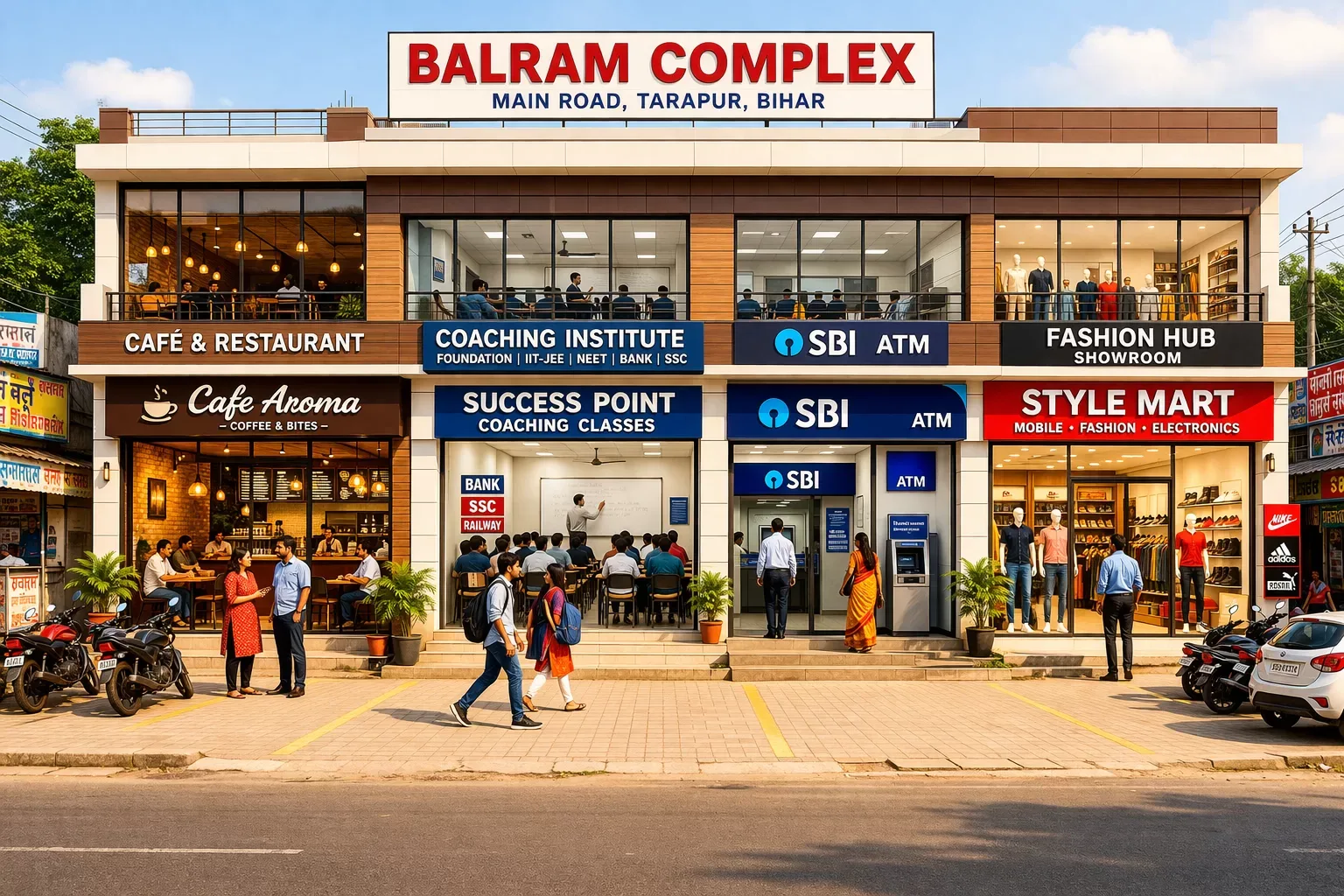
Bihar's latest industrial push gives Tarapur shop seekers a fresh planning signal. On June 3, 2026, Chief Minister Samrat Choudhary directed officials to plan 11 mega industrial parks, set up food parks in all 38 districts, and create a 50,000-acre land bank for future industrial projects. For Balram Complex, the practical question is not whether a large factory will immediately arrive in Tarapur. The real question is simpler: which small shop formats become stronger when Bihar starts organizing more food processing, storage, logistics, and district-level industrial activity?
What changed in June 2026
The June 2026 review of Bihar's Industries Department focused on three linked goals: industrial land availability, district-level food parks, and faster investor support. Reports from the meeting said the state wants 11 mega industrial parks, food parks across all districts, and a 50,000-acre land bank so projects do not get delayed for want of ready land.
The same direction highlighted food processing, textiles, pharmaceuticals, MSMEs, startup growth, and easier approvals as priority areas. That matters for small commercial spaces because industrial growth does not only create demand for large plots. It also creates demand for everyday support businesses around workers, suppliers, small traders, transporters, and service providers.
Why food parks matter for local shop demand
A food park is not just a factory campus. If implemented well, it can support a wider chain of activity: collection, grading, storage, packaging, processing, dispatch, and local sales. That chain usually needs many smaller businesses around it.
For a Tarapur shop seeker, this points toward categories with regular utility value rather than only decorative or occasional demand. The more local food movement and storage infrastructure improves, the more important it becomes to run a shop that solves a recurring problem for traders, workers, farmers, households, or small processors.
The storage signal is already visible
The food-park direction also fits a broader storage and agri-supply trend in Bihar. In March 2026, the Press Information Bureau reported that 36 Primary Agricultural Credit Societies had been identified in Bihar under the World's Largest Grain Storage Plan in Cooperative Sector, with total estimated project cost of Rs 104.3 crore. PIB also said Bihar had already constructed 7,286 godowns under the state plan, creating 17.47 lakh metric tonnes of storage capacity, and that 278 godowns had been sanctioned during 2025-26 for PACS and Vyaparmandals with Rs 180.20 crore released.
The important business takeaway is that Bihar is trying to reduce post-harvest losses, shorten transport distances, and strengthen local storage. When storage and processing improve, local markets can support more reliable product flow. Reliable product flow is what makes smaller retail and service shops more durable.
Which Balram Complex shop formats fit this trend
- Packaged food and grocery retail: Better local processing and storage can support more packaged staples, snacks, pulses, spices, edible oil, flour, and seasonal items.
- Dairy, cold beverages, and frozen products: These businesses still need disciplined refrigeration and stock rotation, but they benefit when supply chains become more organized.
- Packaging and label support: Small producers often need printed labels, pouches, containers, cartons, barcode stickers, and simple branding material.
- Courier, dispatch, and pickup counters: As local producers and traders move more goods, small logistics-support counters become more useful.
- Repair and utility services: Weighing scales, mixers, coolers, small motors, sealing machines, and digital payment devices all need local service support.
- Quick food and worker convenience: Tea, snacks, breakfast, meals, mobile recharge, and daily-use counters work well when worker and trader movement increases.
What not to assume
Shop seekers should stay realistic. A food park announcement does not guarantee immediate footfall at one specific complex. It does not mean every food business will succeed. It also does not remove the need for rent discipline, power planning, inventory control, and clean daily operations.
The safer reading is this: Bihar's policy direction is making food processing, MSMEs, storage, and local enterprise more visible. A shop at Balram Complex should be planned around a clear customer and a repeat-use category, not around vague growth optimism.
How to prepare before leasing
- Write down whether the shop will serve households, workers, farmers, small producers, traders, or visitors.
- Estimate opening stock separately from rent, deposit, and interiors.
- If the business uses cooling, packaging, or machinery, calculate monthly electricity and maintenance before finalizing the unit.
- Choose inventory that turns quickly in the first 60 to 90 days.
- Build supplier relationships early instead of waiting until after possession.
- Keep signage simple and category-specific so passersby understand the shop immediately.
What this means for Balram Complex
Balram Complex is better positioned when its shops are matched to practical local demand. The current Bihar trend supports businesses that are useful every week: food retail, convenience, services, repair, packaging, and small logistics. These formats do not depend only on one festival season or one government announcement. They work when the operator keeps stock tight, pricing transparent, and service reliable.
For shop seekers in Tarapur, the June 2026 food-park push is a reason to plan more seriously around local supply chains. The best opportunity is not simply to open a food-related shop. The better opportunity is to choose a format that connects everyday Tarapur demand with Bihar's wider move toward organized food processing and storage.
Book a site visit if you want to compare available units at Balram Complex and discuss which shop layouts fit food, convenience, service, or dispatch-oriented business models.