
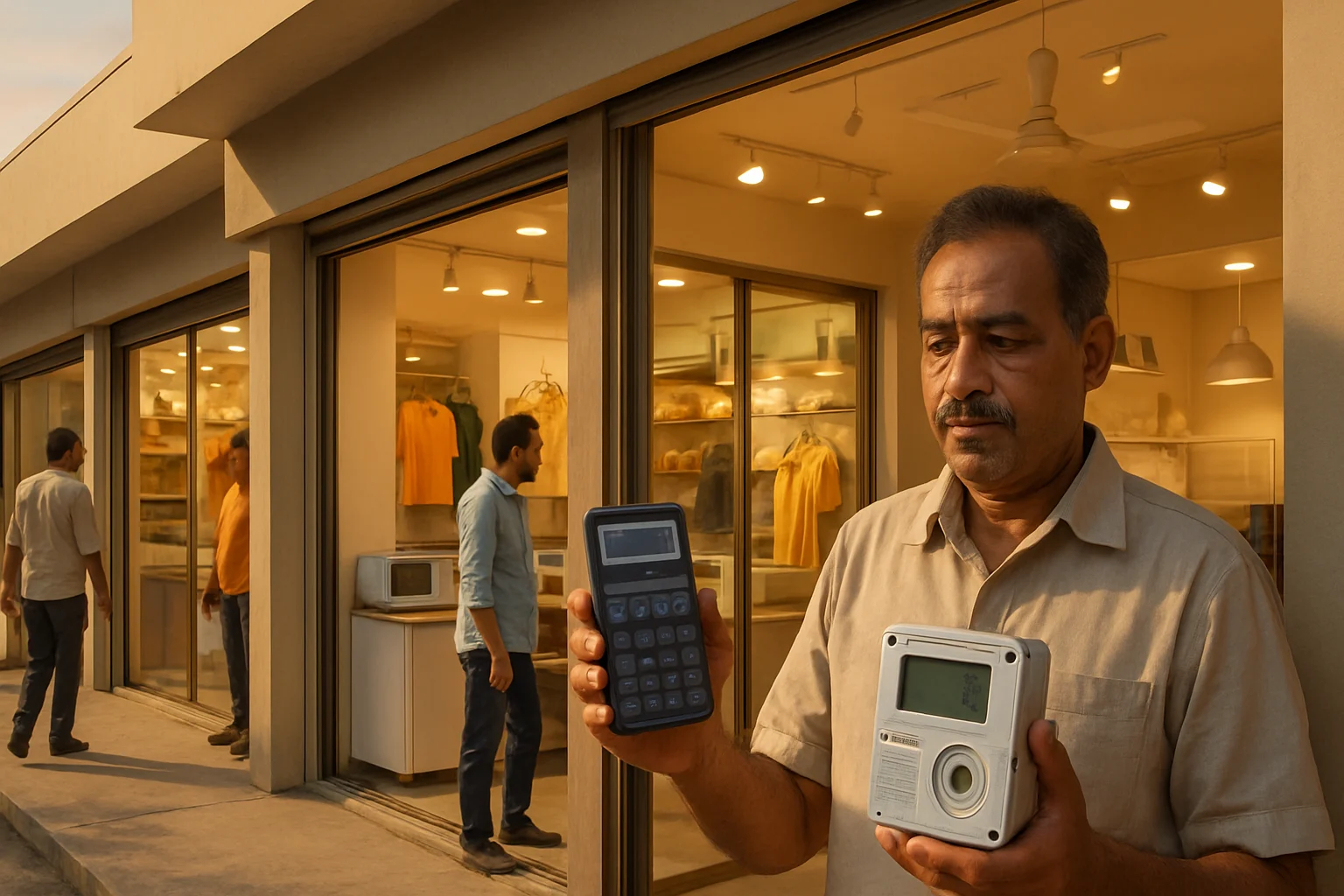
Bihar's new time-of-day electricity pricing is now one of the most practical topics for anyone planning a shop at Balram Complex. From April 1, 2026, the Bihar Electricity Regulatory Commission has made time-based billing mandatory for many non-agricultural consumers. That matters in Tarapur because a shop's monthly electricity cost now depends not only on how much power it uses, but also on when it uses that power.
What changed from April 1, 2026
The Bihar Electricity Regulatory Commission's 2026-27 tariff order made Time-of-Day (ToD) tariff mandatory for two groups:
- all non-agricultural consumers with contract demand above 10 kW, and
- all non-agricultural consumers provided with smart meters, regardless of sanctioned load or contract demand.
For low-tension consumers, the approved structure is simple:
- 9:00 a.m. to 5:00 p.m.: off-peak or solar hours, billed at 80% of normal energy charges
- 5:00 p.m. to 11:00 p.m.: evening peak period, billed at 120% of normal energy charges for NDS-I, NDS-II, LTIS-I and LTIS-II categories, and 110% for other applicable categories
- 11:00 p.m. to 9:00 a.m.: normal tariff applies
That means many small commercial users in Bihar now have a direct financial reason to shift at least part of their electricity-heavy activity into the daytime window.
Why this is more important than a normal tariff headline
For shop owners, this is not just a power-sector policy update. It changes operating behaviour. A business that runs chillers, deep freezers, mixers, air-coolers, printing equipment, sewing motors, compressors, battery charging, or water chilling for long hours during the evening can now feel a bigger cost difference than a shop that moves that same load earlier in the day.
This is especially relevant for Balram Complex because many likely shop formats depend on repeat daily footfall and moderate but regular electricity use rather than one large industrial load. In that setting, even small timing changes can protect margin.
There is also some relief in the 2026-27 Bihar tariff order
The same BERC press release also said the Commission did not accept the DISCOM proposal for a flat 35-paise per unit increase across categories. It also approved some rationalisation on the non-domestic side, including:
- merger of NDS slabs while keeping the existing lower-slab energy charge, and
- reduction in fixed charge for NDS-II consumers up to 0.5 kW from '200 to '150 per connection per month.
So the real 2026 planning question for small Tarapur businesses is no longer only 'Did tariff go up'' The better question is 'Can this shop run intelligently within the new time bands''
Which Balram Complex business types should pay the closest attention
- Cold beverage, juice, ice cream, dairy, and snack counters: refrigeration runs throughout the day, but chilling, pre-cooling, and prep work can be timed better.
- Small grocery and convenience formats: display cooling, storage, and charging loads can be shifted without hurting customer-facing hours.
- Pharmacy, mobile, recharge, and digital service counters: cooling and device charging can be optimized even if the counter stays open into the evening.
- Salon, tailoring, printing, and photocopy shops: part of the work can be front-loaded into daytime if staffing is planned correctly.
- Food-prep formats: grinding, mixing, chilling, or ingredient prep may be cheaper before the evening rush begins.
How a Tarapur shop owner should respond
- Make a simple list of your power-hungry equipment before finalising the business model.
- Separate 'customer-facing' use from 'back-end prep' use. Not every power-consuming activity needs to happen during the costlier 5 p.m. to 11 p.m. band.
- Use the 9 a.m. to 5 p.m. window for pre-cooling, charging, printing batches, water chilling, stock sorting, and other power-heavy prep where possible.
- Keep evening loads lean: LED lighting, efficient fans, disciplined signage use, and only essential cooling or machinery during peak hours.
- If your unit has or may receive a smart meter, do not assume the rule applies only to large consumers. Under the order, smart-meter users are a key affected group.
What this means for shop selection at Balram Complex
Electricity timing now affects leasing quality more than many first-time tenants realise. A good unit is not only about frontage or rent. It is also about how easily the business can operate within the new tariff rhythm.
- If your model depends on prep work, choose a unit that supports comfortable daytime staffing.
- If your category peaks in the evening, plan for tighter control on cooling, display lighting, and non-essential equipment.
- If you are comparing two business ideas for the same shop, the one with easier daytime load-shifting may now be financially safer.
Bottom line
For Tarapur businesses in 2026, Bihar's time-of-day tariff is not a technical footnote. It is a practical shop-planning rule. The businesses most likely to stay efficient at Balram Complex will be the ones that treat electricity timing as part of the business model from day one, especially if they use smart meters or run equipment-heavy formats.
Book a site visit if you want to compare available units at Balram Complex and discuss which shop formats are better suited to daytime-heavy or evening-heavy operations.